
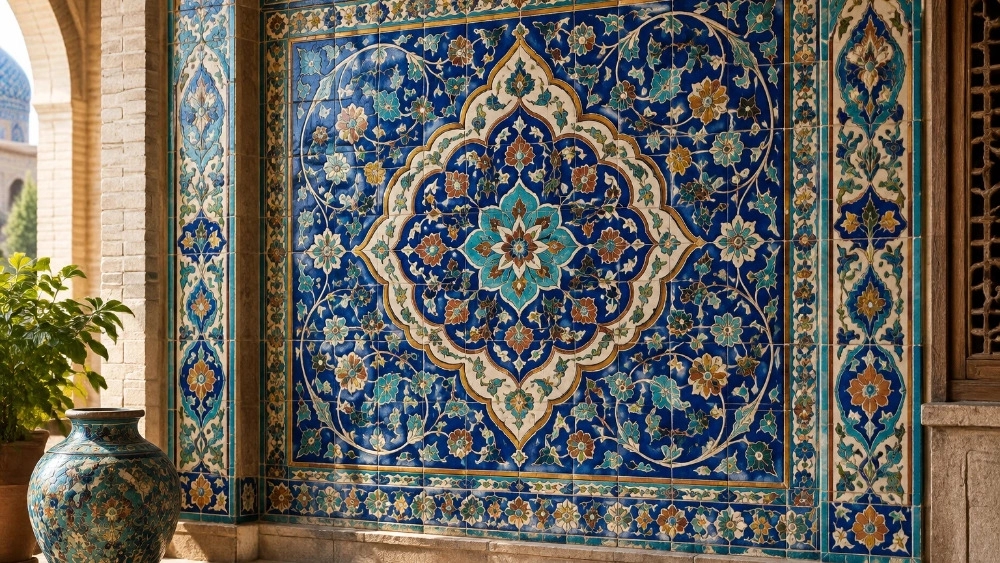
Buying seven-color traditional tiles with an original Iranian design is not just choosing a covering for the wall or facade; It is an opportunity to introduce the color, role and identity of Iranian architecture to the space where we live or work every day. A seven-color tile can turn a simple wall into a focal point of a home, give character to the entrance of a complex, or create a link between the past and the present when renovating an old building. However, design beauty alone is not enough to make a choice. The fit of the pattern with the space, the quality of the body and glaze, the installation conditions and the ordering method also have an effect on the final result.
If you are planning to choose tiles for your home, cafe, restaurant, cultural space or an architectural project, it is better to know before making a decision what design is compatible with your environment and what details you should pay attention to when reviewing samples. In this guide, we will review the selection path from knowing the characteristics of the tile to planning for the order and we will see how the traditional Iranian spring tile can be with you in choosing the right design for the project.
What is the traditional seven-color tile and what are its characteristics?
The seven-color tile is one of the most well-known manifestations of Iranian tile art. In this way, a pattern with different colors is formed on the surface of the tile, and after baking, a combination of lines and lasting colors emerges. The name "seven colors" refers to the well-known method of this art; Each tile is not supposed to have exactly seven colors. What is important is the harmony of the colors and the continuity of the role next to the other parts.
Many seven-color designs are designed as a set. A slime pattern or a central flower may extend over several pieces and be seen only after complete installation. For this reason, when shopping, one should not judge just one piece in isolation. Seeing the general view of the design, its final dimensions and how the tiles are placed next to each other will give you a more accurate picture of the result.
The charm of these tiles is in the combination of elegance and flexibility. A detailed design can be suitable for a feature wall, while a simpler border brings a contemporary space closer to Iranian architecture without overcrowding it. This variety makes the purchase of seven-color traditional tiles with an authentic Iranian design an option to consider both for renovation projects and for the design of new spaces.
Why is the original Iranian design important in choosing tiles?
The originality of a design does not depend only on the oldness of its role. The appropriateness of the lines, regular composition and harmony of colors also play an important role in the formation of the Iranian sense of the work. Patterns such as Slimi, Khatai, Golobote, Taranj and Shamse, each have a different capacity to be used in the space. The right choice happens when the role, in addition to independent beauty, is also in harmony with the architecture of the installation site.
For example, a large wall at the entrance of a cultural complex may require a central and detailed design. In contrast, a small kitchen wall might look better with a row of patterned tiles or a narrow border. Therefore, "genuine design" does not mean the unrestricted use of crowded roles; Sometimes a simple combination shows Iranian identity more effectively.
When examining traditional Iranian spring tile samples, it is better to pay attention to the color of the surrounding materials, the amount of light and the viewing distance, in addition to personal interest in the design. A pattern that is impressive up close may not read well on a high wall. On the other hand, a design with clear lines and appropriate color combination can maintain its identity even from a distance.
The use of seven color tiles in different spaces
Seven color tiles for Iranian houses
In the home space, the use of traditional tiles is as important as the location. The wall behind the vanity, the frame around the mirror, part of the kitchen, the entrance of the house or the wall of a yard can be a good place to create an accent point. It is not necessary to cover all surfaces with patterned tiles. Sometimes, the implementation of a limited frame next to simple walls increases the effect of the design and allows its details to be seen.
In today's homes, combining seven-color tiles with wood, plain plaster, light stone, or neutral-colored metals can create visual balance. If the furniture and other decorative elements are bold, it is better to use the tile in a certain area. If the space is simple and few details, a larger design can give it more personality.
Traditional tiles for cafes, restaurants and residences
Reception spaces usually need an identity that stays in the audience's mind. Tiling in the entrance area, behind the counter, window frame or one of the main walls can strengthen this identity. Of course, the choice of design should be in harmony with the overall concept of the space. For a small cafe, a limited repetition of a pattern may be more appropriate than a wall with a very detailed design.
In restaurants and lodgings, the conditions of daily use are also important. Before ordering, determine where the tile will be installed and whether that surface will be exposed to moisture, frequent washing, or high traffic. This information will help you make a more accurate decision about product selection and implementation method.
Seven color tiles for facades and cultural spaces
At the entrance of buildings, courtyards and cultural complexes, seven-color tiles can be part of the building's visual identity. In these applications, in addition to pattern and color, climatic conditions and installation location become more important. Any decorative tile should not be chosen for an outdoor space without consideration. It is necessary to inquire about the compatibility of the product with the place of execution and its installation method before ordering.
If your project is the renovation of an old building, it will be necessary to pay attention to the dimensions, color and rhythm of the existing motifs. The purpose of adding a new tile is not just to fill an empty surface; The result should look integrated with the remaining parts of the building. For such a project, providing accurate and measured images of the execution site to the manufacturer or supplier set will make the selection path clearer.
What points should we pay attention to when buying seven-color traditional tiles?
Proportion of the plan with the dimensions of the wall
The first question is how the intended role is seen in the actual dimensions of the wall. A large design may not be suitable for a small space or part of it may be hidden behind cabinets and equipment. On the other hand, small patterns on a large surface sometimes do not create the expected visual effect. Before placing an order, measure the length and height of the installation site and determine the location of sockets, valves, doors and other fixed elements.
If the design consists of several pieces, get information about the full dimensions of the pattern and the number of pieces. Examining the image of the plan in the approximate scale of the wall helps a lot in making decisions. In buying a traditional seven-color tile with an authentic Iranian design, the compatibility of the pattern with the execution level is as important as the beauty of the role.
The quality of the role and color
To evaluate the sample, pay attention to the clarity of the lines, the harmony of the colors and the order of connection of the pattern between the parts. In multi-piece layouts, the lines that run from one tile to the adjacent tile must form a coherent image after being laid out. It is better to see the sample under a light close to the light of the installation location; Because the colors do not look the same in natural light, warm light and cold light.
Don't judge the beauty of a tile just from the advertisement photo. If it is possible to examine the sample or more detailed images, also examine the surface details, color and edges. This precision is especially important when you plan to tile a large surface and small inconsistencies will be more visible after installation.
Body, glaze and place of use
The tile chosen for an interior wall is not necessarily suitable for every exterior or every wet surface. Ask about the features of the product suitable for the installation location and explain the environmental conditions in detail. This prevents a choice based only on appearance.
The installation method is also part of the final result. Improper underlayment, uncoordinated lacing or imprecise execution can reduce the effect of even a beautiful design. Before preparing the product, it is better to coordinate with the person responsible for the installation about the dimensions of the parts, the possible layout plan, and the implementation requirements.
The possibility of coordinating design and color
One of the reasons for the acceptance of traditional tiles is the possibility of choosing roles that match the identity of each project. If a certain color is repeated in your interior design or you want a tile frame to match the existing architecture, state your needs before ordering. The pictures of the space, the dimensions of the wall and some samples of the desired colors make the conversation about choosing the design more accurate.
Regarding the traditional spring tile of Iran, it is better to specify from the beginning if you are looking for a ready-made design or if you want to check the possibility of implementing a design suitable for the project. If you need customization, inquire about the possibility of doing it, implementation details and timing. In this way, your decision will be based on the information related to the same order.
How to coordinate the color of the seven-color tile with the decoration?
The colors of the seven-color tile are often the first thing that catches the viewer's attention. However, choosing a color only based on the image of a sample does not always give good results. The color of the surrounding walls, flooring, cabinets, the amount of daylight and the type of night lighting all affect the final effect of the tile.
If your space is small or dimly lit, extensive use of very dark and dense patterns may make the space appear more crowded. In such a situation, you can assign the patterned tile to a limited frame or section and use calmer colors for the surrounding surfaces. In a large and bright space, your hand is more open to choose more distinctive designs, but it is still better to maintain a balance between tiles and other decoration elements.
To achieve a harmonious result, repeat one or two main colors of the tile in other details of the space. This repetition can be seen in fabric, cushions, frames, decorative items or the color of a small piece of furniture. The goal is not to homogenize all elements; It is enough to form a visual connection between the tile and the environment.
Which design is best for your project?
The choice of design depends on the function of the space and the feeling you want to create. Geometric patterns can give certain order and rhythm to the surface. Flower and Khatai designs are usually suitable for spaces that require more elegance and details. Turmeric can also be used to create a focal point in wall frames or entryways.
Before choosing, ask yourself if the tile is going to be the background or the main element of the space. If it is the main element, you can choose a more prominent role and keep the other surfaces quiet. If it is to be seen alongside other prominent elements, a design with less detail or a more limited area is usually a more balanced choice.
When buying a traditional seven-color tile with an authentic Iranian design, it is useful to see different samples, but it is better to make the final decision based on the project conditions, not just the popularity of a design. The right tile for the entrance of a restaurant may not be the right choice for the wall of your home. Dimensions, light, design style and daily use are more reliable criteria for making decisions.
What information should we prepare before ordering Bahar traditional Iranian tiles?
The clearer the project information is, the easier the selection and inquiry becomes. First, measure the exact dimensions of the desired surface and take a photo of it in the right light. Then specify whether you want the tile for indoor or outdoor space, on what surface it will be installed and what colors or patterns you prefer.
If you have seen an example that is close to your taste, provide a picture of it as well, along with a description of the parts you like. Maybe you like the color of the sample, but its role is not suitable for your space; Explaining this difference helps to make a better choice. Also, if you have a specific time to implement the project, raise it from the beginning so that you can inquire about the preparation time and the necessary coordination.
To receive a more detailed offer of traditional Bahar Iranian tiles, prepare a short list of your needs: installation location, dimensions, desired style, preferred colors and approximate quantity. Then ask about the available plans, the possibility of ordering according to the project, delivery conditions and product details. This approach allows you to compare the options with your real needs instead of making a hasty choice.
Why seven color tiles can be a lasting choice for space design?
The traditional seven-color tile, in addition to its covering function, carries images and narratives. This feature makes it more than a decorative element in a properly designed space. A wall with an Iranian pattern can be a point of pause and strengthen the visual identity of a home or business.
The durability of the tile effect depends more than anything on the appropriate selection and accurate execution. A design that is in harmony with the dimensions of the wall and is placed next to the surrounding materials is less boring than a purely emotional choice. For this reason, before buying, it is better to think about both the needs of the space today and the image you want to see in the coming years.
If you are looking for a space with clear signs of Iranian art, buying a seven-color traditional tile with an authentic Iranian design can be a good starting point. Examining the options of traditional spring Iranian tiles and presenting the needs of the project will help you turn the choice from a general interest to a specific and actionable decision.
summary
To choose a seven-color tile, start from the appearance of the design, but don't stop there. The dimensions of the installation site, ambient light, color coordination, sample quality, usage conditions and execution method all have an effect on the result. The original Iranian design is most effective when it is used in the right place and with the right scale.
If you are looking for a tile with an Iranian pattern for your project, prepare pictures of the space and exact sizes and ask for suitable options from the traditional Iranian spring tile. By comparing designs and asking for details before ordering, you can more confidently decide to buy a traditional seven-color tile with an authentic Iranian design.
yes The limited use of seven-color tiles along with simple surfaces and neutral colors can create a harmonious combination in a modern home.
This issue depends on the characteristics of the product and the conditions of the installation site. Before ordering, declare the exterior application and check the fit of the tile and the execution method.
Prepare the dimensions of the surface, the image of the installation location, the type of indoor or outdoor space, the desired design and color, and the desired time for execution.